Bosnia vs Pakistan: Two Flags Compared
Look at a flag and you see a nation. Look closer, and you see a design brief, a history lesson, and a practical object all at once. Comparing the national flags of Bosnia and Herzegovina and Pakistan is not about choosing a favorite. It is a masterclass in how different design philosophies serve different purposes. One leans on tradition, faith, and clarity. The other embraces modern geometry, abstraction, and a complex narrative. For a graphic designer, it is a study in contrast. For an educator, it is a timeline of 20th-century identity. For a business owner ordering stock, it is a question of production cost and quality control. This article unpacks the two flags across these dimensions, helping you see which approach—and which set of priorities—fits your own work, curiosity, or project needs.
First Impressions: The Visual Divide
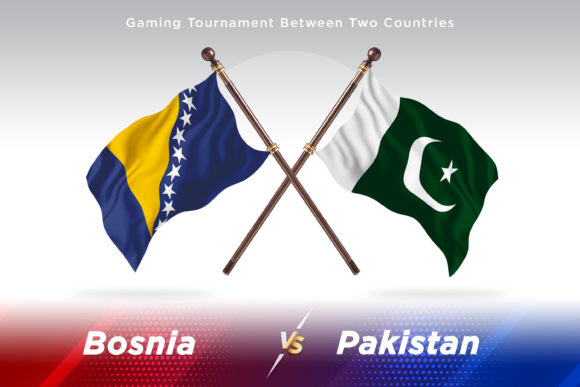
The most immediate difference between the two flags is how they speak to the eye. The flag of Pakistan uses a powerful, minimalistic layout. A deep green field covers most of the fabric, with a white vertical band on the hoist side. Centered on the green is a white crescent moon and a five-pointed star. The composition is balanced, iconic, and instantly readable. You can sketch it from memory after seeing it once. This simplicity is a superpower—it works at a distance, at a small size, and in poor light.
The flag of Bosnia and Herzegovina demands more attention. It uses a blue field, a yellow isosceles triangle running from the top to the bottom edge, and a diagonal line of white stars—seven full stars and two half-stars clipped at the edges of the flag. The geometry is specific. The triangle represents the approximate shape of the country, while the stars connect the design to European symbolism. For a beginner learning to draw flags, Pakistan is a quick win. Bosnia requires care with the angle of the triangle and the precise placement of the stars. For a digital creator making thumbnails or social media cards, the Pakistan flag will pop at small resolutions. The Bosnia flag, with its delicate stars and subtle diagonal line, looks best on a larger canvas where the details have room to breathe.
Symbolism: What Each Banner Tells the World
Flags are condensed stories, and the stories behind these two designs are very different. Pakistan’s flag is rooted in the ideology of its founding in 1947. The green field represents the Muslim majority, while the white bar represents religious minorities—a commitment to pluralism at the nation’s birth. The crescent stands for progress, and the star represents light and knowledge. It is a flag that explicitly communicates political and religious identity. For an educator teaching about South Asian history or political symbolism, this is a textbook example of how a nation can encode its founding principles into a simple visual mark.
Bosnia’s flag, adopted in 1998, is a product of a different kind of nation-building. It was designed after the Bosnian War, with the explicit goal of representing a multi-ethnic state without favoring any single group. The blue and yellow are taken from the European Union flag, signaling a pro-European future. The triangle is a direct geographical reference to the shape of the country—a rare and bold choice in flag design. The stars are infinite in number, meant to symbolize continuity and unity. For a history or political science educator, this flag is a powerful tool for discussing post-conflict reconciliation, civic identity versus ethnic identity, and how countries literally redesign themselves after crisis. A hobbyist who enjoys digging into the meaning behind symbols will find a richer, more layered story in the Bosnian flag. A casual learner might appreciate the straightforward clarity of the Pakistani standard.
Practical Production: Cost, Quality, and Reliability
Moving from theory to the real world, the two flags behave very differently in manufacturing and digital use. This is where business owners, procurement professionals, and event organizers need to pay attention.
The flag of Pakistan is relatively simple to produce. Two colors, one straight seam for the white vertical band, and a clean printed or embroidered emblem. The materials cost is lower, and the consistency between manufacturers is high. It is a workhorse flag for outdoor use. The bold green and white fade gracefully because the color blocks are large and solid.
The flag of Bosnia requires more precision. The diagonal cut of the yellow triangle against the blue field demands accurate sewing or printing. The arrangement of the nine stars—especially the half-stars at the top and bottom—is a frequent point of error in cheaper production runs. If you are ordering flags for an international event or a permanent display, you need to verify that the manufacturer understands the specific geometry. The detailed design means it has a higher risk of quality variance.
Example for a small business owner: You are sourcing flags for a cultural fair. Ordering one hundred Pakistan flags is a standard task with predictable results. Ordering one hundred Bosnia flags requires a checklist: Are the stars correctly positioned and oriented? Is the yellow triangle the exact shade specified by law? Is the diagonal line straight? The Bosnia flag costs more to make well, and a poorly made version looks obviously wrong. For a marketer or blogger creating an infographic or video background, the Pakistan flag renders beautifully in small thumbnail sizes. The Bosnia flag needs a larger space to properly show its diagonal structure and stars—it looks cluttered if scaled down too much.
The Collector and Creator Perspective: Understanding Classic versus Modern
For flag enthusiasts (vexillologists) and creators such as worldbuilders, game designers, or content creators, the two flags offer contrasting templates for how to build a national identity through design.
Pakistan’s flag is a classic. It fits into a well-established tradition of Islamic flag design, but stands out due to its unique white vertical band and the specific proportions of the crescent and star. It feels timeless and grounded. If you are designing a flag for a fictional country with a strong unifying ideology, this is a proven model: one clear symbol, one dominant color, and a clean layout. It communicates strength and tradition.
Bosnia’s flag is a modern outlier. It breaks traditional rules of flag design—it looks almost like a corporate logo or a geographic diagram. The use of a map-based shape (the triangle) and the scattered stars was controversial among traditional vexillologists when it was adopted. However, that uniqueness is what makes it interesting for a creator. If you are building a fictional nation that has been reborn after a conflict, or one that is geographically fragmented, the Bosnia flag shows you how to use abstract geometry to tell that story. It prioritizes uniqueness and narrative over instant recognizability. A hobbyist collecting world flags values the Bosnia flag for its rarity of design—there aren’t many other national flags that use a similar layout. It has high interest value because the specific placement of the half-stars is often debated and frequently drawn incorrectly, making the correct version a mark of quality knowledge.
Which Philosophy Fits Your Project or Needs?
Both flags are excellent examples of their respective design approaches. The question is not which flag is better, but which set of trade-offs matches your specific context.
You will likely prefer the strengths of the Pakistan flag if:
- You need a flag that is instantly recognizable at a distance or in a small format.
- You are working on a budget-friendly production run and need reliability across different manufacturers.
- You value straightforward, powerful symbolism that is easy for a general audience to understand.
- You are a beginner looking for a clean template for a design project or study.
You will likely prefer the strengths of the Bosnia flag if:
- You are producing high-quality print or digital work where fine details can be appreciated.
- Your project benefits from a deeper, more complex story behind the design (documentaries, deep-dive articles, educational materials on modern history).
- You prioritize unique geometry and a modern aesthetic over classic simplicity.
- You are an experienced designer, educator, or hobbyist who values nuanced, multi-layered national symbolism.
In the end, comparing these two flags reveals how much a single piece of cloth can carry. One is designed for immediate impact and clear identity. The other is designed for long engagement and layered storytelling. Both do their jobs exceptionally well—it just depends on the job you need done.